How Much Does a Website Cost in Australia? A Clear Breakdown (2026)
Website
Strategy
Pricing
Short answer:
Website costs in Australia vary widely - from a few thousand dollars to well over $30,000 - depending on scope, complexity, and long-term goals.
The longer (and more useful) answer is below.
This guide breaks down what actually affects website pricing in Australia, what you should expect to pay in 2026, and how to avoid overpaying - or under-investing - in the wrong areas.
Why website pricing varies so much
When people search “How much does a website cost in Australia?”, they’re often comparing quotes that feel wildly inconsistent.
That’s because a website isn’t a single product. It’s a combination of:
strategy
design
development
content
SEO
performance
ongoing support
Two websites can look similar on the surface and still have very different costs and outcomes.
Pricing differences aren’t only driven by features or page count - they’re also influenced by how the work is delivered and by whom.
The main factors that affect website cost
1. Scope and number of pages
This is one of the most obvious cost drivers.
1–3 pages (brochure or landing page): lower cost
5–10 pages (services, about, content): mid-range
10+ pages or custom structures: higher investment
More pages usually mean more:
design decisions
content work
testing and QA
SEO setup
2. Design complexity
Not all “custom design” is the same.
Template-based or lightly customised designs cost less
Fully custom layouts, animations, and transitions cost more
Advanced UX work, micro-animations, and interaction design require more time - and time directly affects cost.
3. Content and copywriting
Content is often underestimated.
Key questions to consider:
Are you providing final copy, or does it need to be written or refined?
Does the content need to be SEO-optimised?
Is the messaging already clear, or does it require discovery and strategy?
Strong content improves clarity and conversion, but it does influence pricing.
4. SEO and discoverability
Basic SEO setup is very different from SEO done properly.
Basic SEO: page titles, meta descriptions, heading structure
Optimised SEO: site structure, keywords, internal linking
Advanced SEO: local visibility, Google Business Profile, AI-search readiness
If your website needs to support organic growth, SEO should be considered part of the build - not an afterthought.
5. Functionality and integrations
Additional functionality increases complexity.
Common examples include:
booking systems
CRM integrations
email marketing tools
analytics and tracking pixels
custom forms and workflows
The more systems involved, the more planning, testing, and coordination are required.
6. Performance, security, and long-term support
High-quality websites don’t just look good - they perform well over time.
This includes:
fast load times
stable infrastructure
security best practices
ongoing updates and support
Post-launch support is often included for a limited period or offered as an ongoing plan, and this affects overall cost.
Agency size also impacts website cost
Another important factor in website pricing is who you work with.
Large agencies, small studios, and independent teams operate very differently - and that difference is reflected in pricing.
Large agencies often have higher overheads, multiple layers of management, and more rigid processes. This can result in higher project costs, even for relatively straightforward websites.
Small studios or senior-led teams tend to be leaner and more flexible, with direct communication and fewer layers. This often allows for faster delivery and more efficient use of budget without compromising quality.
Neither option is inherently better - the right choice depends on your needs.
Large agencies may suit complex, enterprise-level projects, while smaller teams often excel at focused, high-quality delivery with less overhead.
Understanding this difference helps explain why two quotes for similar-looking websites can vary so widely.
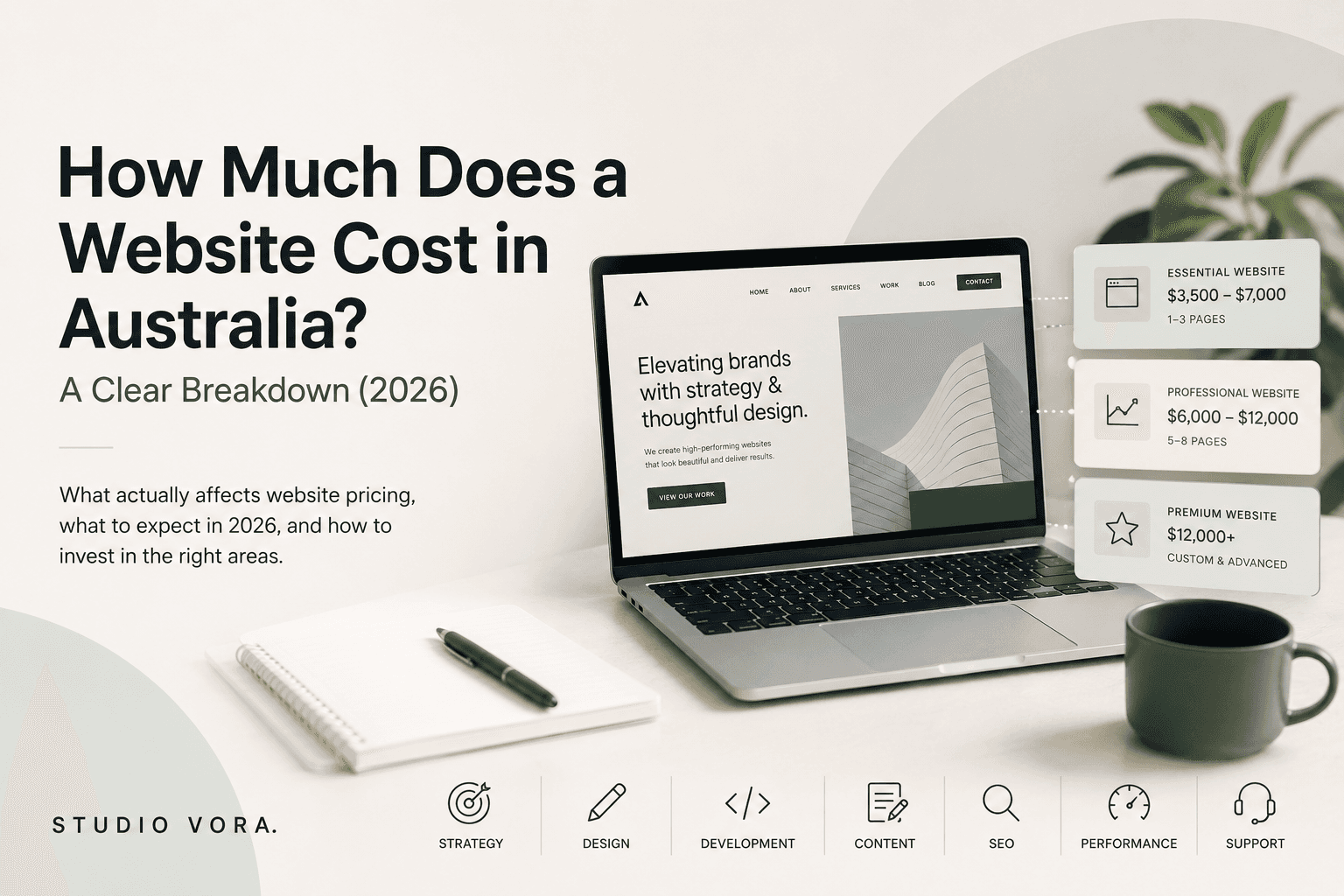
Typical website cost ranges in Australia (2026)
Essential website - AUD $3,500 to $7,000
Best for:
small businesses
solo professionals
local services
Typically includes:
1–3 pages
clean, mobile-first design
basic SEO setup
contact form
basic performance optimisation
Professional website — AUD $6,000 to $12,000
Best for:
growing businesses
service-based companies
brands that need credibility and structure
Typically includes:
5–8 pages
refined design with micro-animations
content structure and copy refinement
SEO-optimised site structure
performance optimisation
analytics and tracking setup
Premium or custom website - AUD $12,000+
Best for:
established businesses
companies with complex needs
brands focused on authority and scale
Typically includes:
custom UX and design
advanced animations
full copywriting
advanced SEO foundations
integrations (CRM, booking, APIs)
documentation and training
extended post-launch support
Common mistakes that increase cost (without increasing value)
Starting without clear goals
Lack of clarity leads to expensive revisions later.Over-engineering too early
Not every business needs complex systems from day one.Choosing a platform before defining needs
Tools should support the business - not dictate it.Underestimating content
Poor messaging can undermine even the best design.
How to budget smarter for your website
Before requesting quotes, ask yourself:
What is the primary job of this website?
Who is the audience, and how do they make decisions?
Do we need speed-to-launch or long-term flexibility?
Will this website support SEO and growth over time?
Clear answers lead to clearer scopes - and more accurate pricing.
A practical approach to website pricing
At Studio Vora., we look at:
your business model
your audience and messaging
technical requirements
long-term growth plans
This allows us to recommend the right structure, platform, and level of investment - without unnecessary overhead.
Final thoughts
There’s no single “correct” website price in Australia.
The right budget is the one that:
supports your business goals
avoids over-building
creates a solid foundation for growth
If you’re planning a new website in 2025 or comparing quotes, clarity will always deliver more value than chasing the lowest number.
Thinking about your next website?
If you want help defining scope, choosing the right platform, or understanding what level of investment makes sense for your business, feel free to get in touch.